Thursday, 25 August 2011

We Don't Make Places On Our Own

I recently read Tim Cresswell’s Place: A Short Introduction (2004), and was struck by how different concepts about what makes a place can be so thoroughly and imaginatively explored, and yet never once mention non-human animals in more detail than a hand waved vaguely in the direction of ‘nature’. Yet animals were lingering silently behind all of Creswell’s main points, and I’ll give an overview below.

Places are not static; they are continuously created anew by the activities of their inhabitants.
Creswell talks about people all over the world engaging in place making activities. Unless he is using the term ‘people’ to refer not only to homo sapiens sapiens, but the peoples of the non-human races as well (and I’m thinking not), he is seriously missing a trick here. Animals are arguably more inside their environments than we are. I may sit at my desk at work for eight hours a day, but my mind is somewhere else for at least seven. As mentioned in a previous post, pretty much every animal engages more with its surroundings than do humans. Animals are constantly in the process of exploring and modifying their environments, which is part of what is so horrific about barren factory farm stalls, where they are unable to satisfy these instincts.

Place is used in the construction of ideas about who/what belongs where, and who/what does not belong
Creswell explores this idea through looking at homeless people and homosexuals. One might explore it further (in a pretty heft tome) by looking at the placement/displacement of animals. We take them out of places they belong. We put them places they don’t belong. We make judgement calls on where they can fit in and where they can’t. We create whole races, like the domestic dog, by taking a species out of one environment and making it reliant on another.

Culture transforms the natural environment
By ‘culture’ Cresswell refers specifically, of course, to human culture, i.e. positioning nature/animals outside of the sphere of cultural places. Chris Philo, in his essay Animals, Geography and the City: Notes on Inclusions and Exclusions challenges the notion of non-human animals existing outside the sphere of human culture.

…’the possibility is raised here of thinking about animals as a social group with at least some potential for what might be termed ‘transgression’ or even ‘resistance’ when wriggling out of the cages, fields and wildernesses allotted to them by their human neighbours…’(In Animal Geographies, eds Wolch & Emel, 1998).’
To dwell in a place you must understand and follow its rules
This is one of the points that Foucault makes about his Heterotopias, and similar to Henri LeFebvre’s conception of Social Space. Socially constructed places have unwritten rules, which must be followed by the inhabitants. A single species tends to understand the nuanced rules of its habitat; interlopers must pick up on these or face being seen as transgressors and trouble makers. The majority rule in most situations, except in those predominantly non-human habitats culturally constructed by humans for other species. Zoos and animal shelters are two places where animals are often seen to transgress in ‘their own’ environments. Yet they are following rules – just not ours.

Modern places are increasingly marked by a new ‘placelessness’
This again speaks to Foucault’s Heterotopias, abstract spaces which are constructed out of a collection of other spaces, for example gardens, or museums. These spaces become ‘placeless’ because they lack their own intrinsic meaningfulness.  This appears at first blush to be a specifically human construct. But what of animal collectors, such as magpies? Is the magpie’s fabled nest of appropriated items a heterotopia?

In modern society spaces are increasingly ‘consumed’ through photography, cinematography, tourism and other media.
Technologies allow and encourage the fetishisation of places. We put pictures of foreign places on our living room walls and on our screensavers. Undeniably, animals feature largely in our consumption of other places; a Serengeti scene features a herd of wildebeest, an ocean scene features seagulls. It could be said that the place is only complete, and therefore ready for consumption, when it features the animal inhabitant associated with it.

We have an irresistible urge to mark out boundaries, barriers and frontiers.
This is talked about as a fascinating human phenomenon, but this is one irresistible instinct that we share with our brothers-from-another-mothers, aka, all the other species. Take a look at Robert Ardrey’s The Territorial Imperative (1966) for an alluring insight into the ways that species mark out ‘my land’ vs ‘your land’.

Obviously, as an anthrozoologist, I see animals everywhere, present in every philosophical debate, every pop culture phenomenon. Yet, for all the intelligent and insightful piece of writing on Place: An Introduction, there is an elephant in the room, and Creswell either doesn’t see it, or doesn’t see an audience for it. It emerged this week that there are something close to 9 million individual species on our planet. To see only ourselves is not to see at all.

Animal Sensuality

A few months ago I visited an ashram named Skanda Vale, near Lampeter in Wales. Our  MA Anthrozoology group went there to talk to the resident Swamis about their relationships with the animals living at Skanda Vale, which covers an entire valley, and is home to indigenous and exotic species, including donkeys, goats, rescued poultry birds, a herd of water buffalo, and an elephant named Valli, gifted to the ashram by Sri Lanka. Although the ashram brands itself as a ‘multi-faith community’, the main precepts that it is run by are Hindu in origin, and consequently it is a place of pilgrimage for Hindus from across the globe. Within Britain, Skanda Vale is most commonly known through the media coverage surrounding the killing of the bull Shambo. In 2007 Shambo was diagnosed with bovine TB, and the Swamis and other human residents of the ashram entered into a long and bitter dispute with Defra regarding Shambo’s fate. Despite Skanda Vale arguing that Shambo was sacred to them, Defra prevailed, and Shambo was destroyed.
We were forewarned that the episode with Shambo was still raw in people’s minds, and the topic wasn’t raised. Instead, the swamis spoke in a more general way about their respect for the animals that they share their lives with, with many of them devoted sole carers for a particular species living at the ashram, spending almost all their waking hours caring for their charges. One swami happened to mention that caring for the resident herd of water buffalo was a good way for him to practice mindfulness.

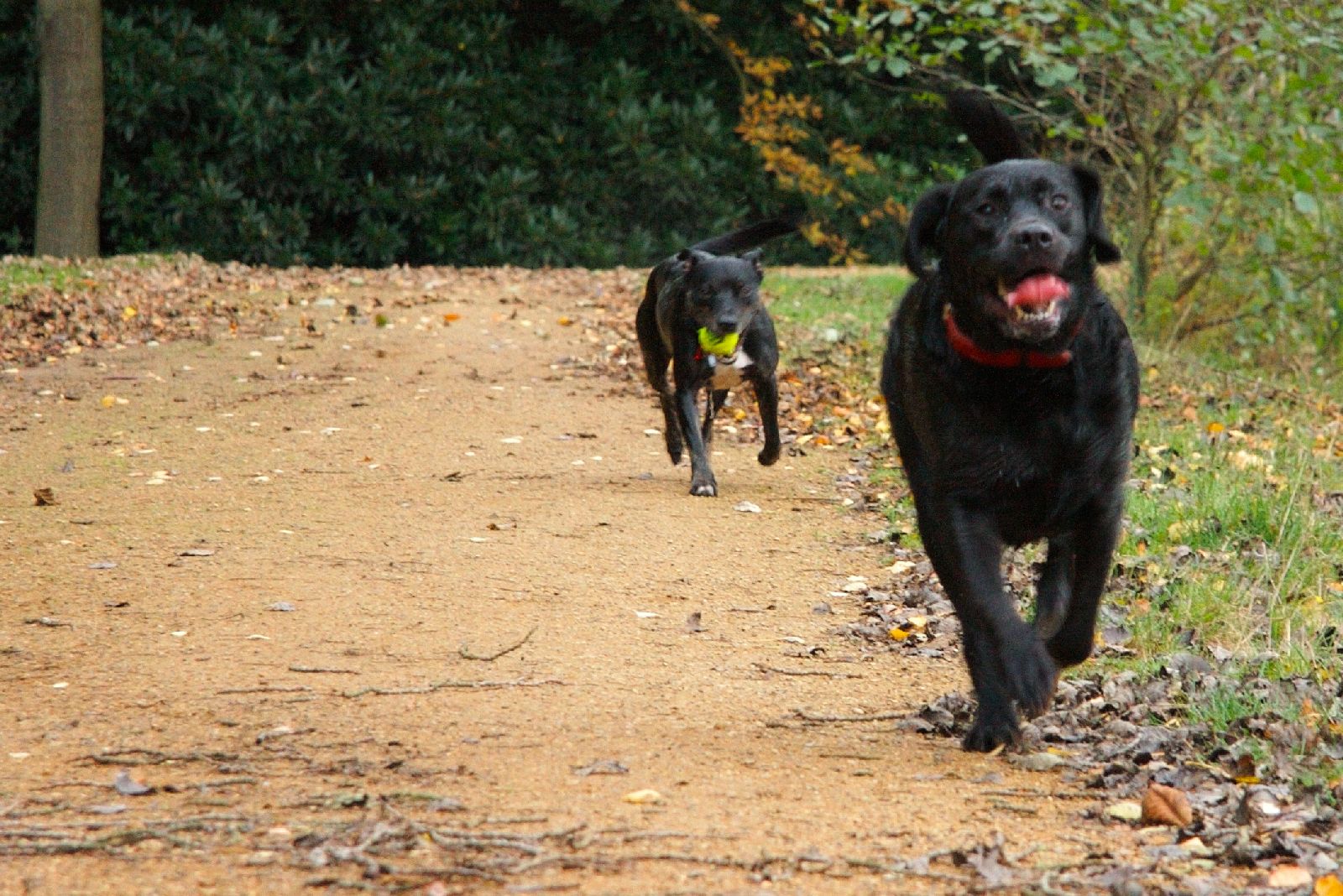
This mindfulness idea has been popping into my head ever since the ashram visit. The aim of mindfulness is to be able to dwell completely inside the present moment, with no thought of the past or of the future. It’s considered a holy state to be in for many religions. I’ve tried it. It’s really, really hard to sustain for longer than a few moments. But somehow its always easier with animals around. For a couple of years now I’ve been walking Battersea Dogs Home’s canine residents every Sunday, and I think I understand how the swami is aided by his buffalo companions. It’s a tired old cliché that animals live in the moment, but that tired old cliché is true. And you can’t help living there with them.

It’s August. It hasn’t been a summer to write home about, but we’ve had a few idyllic blue sky days, and today was one of them. With sheer, exultant joy, a six stone Husky, (who up until now has been the very picture of aloof poise) launches himself into the cool waters of a paddling pool. The split-your-face grin of a fat little Staffie bitch as she collapses belly-first into a patch of moist green grass and clover, and splays her little legs behind her like a frog, is one of the sweetest things I’ve ever seen. In my capacity as dog walker, I spend all winter wishing it was summer, and all summer dreading winter. When have I ever just engaged with my surroundings the way that these dogs do? They have the mindfulness of a Buddha (if not the calmness), and it takes no effort at all.


In the lushly written The Spell of The Sensuous (1996) ecologist David Abram advocates the deeply mindful use of all our senses in regaining a connection with nature and our surroundings, as a way of reminding ourselves what we have to lose, before it is too late.

Without the oxygenating breath of the forests, without the clutch of gravity and the tumbled magic of river rapids, we have no distance from our technologies, no way of assessing their limitations, no way to keep ourselves from turning into them…Caught up in a mass of abstractions, our attention hypnotized by a host of human-made technologies that only reflect us back to ourselves, it is all too easy for us to forget our carnal inherence in a more-than-human matrix of sensations and sensibilities. Our bodies have formed themselves in delicate reciprocity with the manifold textures, sounds and shapes of an animate earth – our eyes have evolved in subtle interaction with other eyes, as our ears are attuned by their very structure to the howling of wolves and the honking of geese. To shut ourselves off from these other voices, to continue by our lifestyles to condemn these other sensibilities to the oblivion of extinction, is to rob our own senses of their integrity, and to rob our minds of their coherence. We are human only in contact, and conviviality, with what is not human (Abram, 1996, my italics).
Abram’s frequent use throughout the book of technology as a counterpoint to sensuality can’t help but hark back to Andrew Feenberg’s work on the Philosophy of Technology, and the Determinist viewpoint that technology, rather than being human controlled, is in fact, controlling us. The new awareness that allowing ourselves to experience the ‘spell’ of sensuality can awaken in us, just might be enough to break the ‘spell’ of technology, that we are currently (considered to be) under.

Animals make us mindful, and not just in a vicarious way, but in a deeply sensual way too. As Abram points out, we have evolved to be tuned into them. Think about the sound that crickets make on a summer evening, or of a bee buzzing past your ear. The way that warm dog fur feels on your palm, the way it smells.  The sight of a glossy, red ladybird against a green leaf. The easiest way for us to spread our awareness into our surroundings is for those surroundings to have animals in them. Sure, cars could work too. The sound of engines revving. The taste of smog-air in your mouth. It’s no wonder we’ve retreated into personal space bubbles with sensory stimulation like that on offer. And, as Feenberg points out, man-made things simply reflect us back at ourselves. There is no sensory journey to compare to that of experiencing another being as it experiences us, and engages with its surroundings.

It’s strange to think that we might be able to save the future by thinking simply about the present… if only for a little while.


Sunday, 7 August 2011

Suckling the Witch's Familiar

Medieval Britons, and those even as recent as 18th century Britons, saw witchcraft everywhere. The witches in question, although sometimes male and occasionally of the ruling elite, most often came in the form of rural village women, and were most often accused by their own neighbours. Interestingly, in the brilliantly titled Malevolent Nurture (1995), Deborah Willis finds that the accusers, too, were mainly females; the neighbours of the indicted.


Proof of witchcraft came in the form of muttered so-called ‘curses’ followed by the target of the curse experiencing some sort of ill fortune; failed crops, a sow that wouldn’t feed her piglets, even a death. The other form of proof came in the testimony of those who had seen the accused with a small animal, or animals. The accuser might have seen the ‘witch’ leaving food out for a dog or tending to an injured bird. She might even be known to house animals in her cottage overnight.
It was common knowledge that a witch would have a familiar, and indeed there are numerous testimonies from self-confessed witches (although the methods of torture used in order to glean a confession could be brutal, and it’s hard to pinpoint who truthfully considered themselves a witch) regarding their species and special names. Depending on the time and locality, this familiar was alternately seen as a demon that did the witch’s bidding, or the devil himself, guiding and instructing the witch whilst in the guise of an animal. The animal in question, then, was not considered to be an ‘evil animal’ per se, rather, it was seen as a vessel, a container for the demonic spirit within. Animals were non-reasoning beings and did not have the capacity to be evil in and of themselves.

Once the accused was brought before trial there was one surefire way to determine whether she was a witch or not. This was the Devil’s Teat. A mark on the witch’s body, which could look like anything from an actual third nipple, to a scar, birthmark or mole, and with which it was said that the witch was able to suckle her familiar, either with milk (which was believed to be generated from blood) or with blood itself. Once the mark was found (and it inevitably was, a woman would have to be impossibly blemish free to escape) it was considered solid evidence of the witch’s maleficium.

Having taken the suspected witch, she is placed in the middle of a room upon a stool or table, cross legged, or in some other uneasy posture, to which if she submits not, she is then bound with cords; there she is watched and kept without meat or sleep for the space of 24 hours for (they say) within that time they shall see her imp come and suck. A little hole is likewise made in the door for the imp to come in at; and lest it might come in some less discernable shape, they that watch are taught to be ever and anon sweeping the room, and if they see any spiders or flies, to kill them. And if they cannot kill them, then they may be sure they are her imps. (John Gaul, Select Cases of Conscience touching Witches and Witchcrafts, 1646)
In Malevolent Nurture Willis borrows heavily from the work of Melanie Klein to demonstrate how women who were often past the child-bearing age, either widowed or spinsters, and who might be poor and forced to ask other neighbours for help or charity, were prime targets for the accusation of witchcraft. Their muttered ‘curses’ were frequently a response to neighbours telling them essentially to get lost when they asked for help. In psychoanalytic terms the neighbour, often younger than the accused, who had rebuffed the plea for charity can be seen to identify the older woman’s helplessness as a lack of maternal grace and dignity. In psychoanalysis every older woman represents ‘the mother’, and therefore, when ‘the mother’ is seen to plead for help ‘the child’ is put in an uncomfortable, guilt-inducing position.
Willis is strongly into the psychoanalytic interpretation of the patterns of these events, which may or may not apply to these cases. If we allow for this train of thought though, it could arguably be said to follow on that the disgruntled neighbour, seeing the poor old woman nurturing or caring for a small animal, considers this a perverse enough action to be an indicator of more sinister forces at work.

  1. The old (or old-er) woman can barely afford to keep herself
  2. The older woman might have often asked for charity for herself
  3. The older woman is seen caring for a dumb animal
  4. There must be a reason for the old woman to want to care for the animal.

There must be a reason for the old woman to want to care for the animal. It was not understood that an old woman might try to fulfil her urge to nurture with the only thing that she was able to help – a small animal. It was not seen that the old woman, often maligned within her community, might feel a sense of appreciation from the rabbit, or the dog, or the sparrow that she helped. The only explanation for a woman to be taking the time to care for something small, vulnerable, and distinctly non-human, was that the animal was not an animal at all.


Strikingly, despite the Europe-wide belief in witches, the notion of the ‘sucking familiar’ is actually geographically limited to England (see M.A. Murray, Witches’ Familiars in England). How the transgression of feeding an animal with some bread or a bowl of milk could become, in people’s minds, all the more deviant with the idea of the actual suckling of the animal on the witch’s own flesh, shows us the deep sense of threat felt by those (i.e. the majority) who could not conceive of a relationship between a human and an animal. Understanding this viewpoint requires a deeper investigation into the more general attitudes towards animals of the time.

Sunday, 31 July 2011

The Sweet Smell of Civet, or, Why We Wear Animal Perfumes


Tap into a woman’s inner animal with the right fragrance…Found in high concentrations in most towns and cities, the wildcat stays out late to indiscriminately sink her claws into those who take her fancy. A fragrance containing musk is a must – its high molecular weight means it releases slowly, and will still be giving off signals long after the chip van has packed up. Try Boss Bottled Night (£36.00 for 100ml, boots.com). Don’t say you weren’t warned. (Men’s Health 2011).

There are four main animal ingredients in perfumery: musk, civet, ambergris and castoreum. Musk originates from the musk deer, Moschus moschiferus, civet from the civet cat, Civettictus Civetta, ambergris from the sperm whale and castorem from the beaver. In the fragrance world the ingredients taken from these species are known as The Big Four, and they translate into Big Bucks. Lately, most of the off-the-shelf perfumes that we wear contain, not real animal ingredients, but synthetic imitations, designed to replicate the fragrance (and presumably the effect) of the real deal. This does not show a touching concern for the species, as much as a concern for the economic bottom-line. The musk deer, for example, is endangered, and does not thrive in a farmed environment. Supply, therefore, is unstable at best. The most stable supply, and so still used in many perfumes, is civet. Unfortunately for the civet cat, it has shown itself to be able to survive even in tiny cages, and is farmed extensively in Ethiopia, where civet keepers routinely torture and enrage the beasts, because the volume of excretions goes up the more agitated the animal gets.  


It seems strange to think that humans could be so attracted to the idea of wearing another animal’s glandular excretions on our skin, particularly in light of the normal associations that we make with the ‘animal’ or ‘animalic’ . In The Odour of the Other (1992) Constance Classen speaks of olfactory codes ‘pervading classificatory thought’, i.e. that odours can be as totemic as the visual. Yet throughout most of our human history any association with the animal has been contextualised in derogatory terms, i.e. dirty, unsophisticated, lowly, bestial. So why the seemingly contrary urge to associate ourselves with the smell of a beast?

Well, despite the fact that the animal ingredients (or in our age, predominantly synthetics) are used in both male and female fragrances, traditionally it is the male fragrances that have tended to be based around these smells. Strong, musky, sweaty, heady odours are the realm of the male eau de cologne. In contrast, female fragrances have tended to use the musks or civets as a subtle background to the more obvious fruity or floral notes. So do men want to see themselves as beasts, and do women want to see themselves as flowers? Absolutely not.


I think my point can be best illustrated by examining current day fragrance advertising. The male is depicted, not as an animal, but as an explorer. He is on a horse. He is captain of a ship. He is sailing a boat. The female, on the other hand, is depicted as an animal. A pussy cat or a tigress, an exotic bird, even a unicorn. The man, depicted as adventurer, or indeed coloniser, is very much a human. If he is shown with any animals, he is in a position of dominance over them. Eventually, it becomes clear that the man is willing to associate himself with the animal because this is the way to attract the exotic, the animal female. By wearing animalic fragrances the human male attempts to send ‘come hither’ signals to the female. It is the female that the male is associating with animal-ness, not himself. While the female, the animal, is sometimes predator and sometimes prey, the male is always, and simply, conqueror.


Sunday, 24 July 2011

Does One Globe Equal One Animal Ethic?

This week I’ve been reading Peter Singer’s 2002 book One World: the Ethics of Globalisation. Although Singer is most famous/infamous for his work on animals and ethics, he focuses on the increasingly globalised ‘community’ of humans in One World, with animals cropping up mainly in the abstract, in the form of references to ‘our environment’. However, the ideas, I would say, can be as easily applied to ‘foreign’ animals as they can to foreign human beings, and so I’ve compiled a cheat sheet of the pertinent questions raised by Singer.

  1. To what extent should we be concerned for ‘our own’, and to what extent should we be concerned for the ‘other’, who lives ‘elsewhere’?
  2. If we should be more concerned for ‘our own’, why is this?
  3. Is the person who kills somebody indirectly, for example through driving a gas guzzling Chelsea tractor, as culpable as the person who kills somebody directly, for example through the medium of stabbing with a sharp knife?
  4. If another country’s leaders are accused of genocide/pollution/miscellaneous atrocities, does trading with that country imply an ethical judgement, or is trading with that country value-neutral?
  5. Is knowing about atrocities in another country and not doing anything about them, as bad as knowing about atrocities in our own back yard and not doing anything about them?
  6. Is imposing our own culture onto other, foreign cultures, a force for good or evil?
It is quite interesting to compare instinctive reactions to these questions when thinking about humans, with the instinctive reactions when thinking about animals. No answers, though, just food for thought…

Sunday, 10 July 2011

Moral Responsibility in a Technological Era

We live in an age of moral irresponsibility. By that, I do not just mean that humans perpetrate immoral, or amoral, acts and fully expect to get away with them (although they do). I mean that the blame for these things always seems to be split and dispersed, with too many culprits for anyone to actually be culpable.

Take orangutans. Indonesia is the country with the fastest rate of deforestation in the world. Who is responsible for razing the home of the old man of the forest? The palm oil traders, like Cargill and ADM? Ok, who within the corporation will take responsibility? The Chief Exec? His advisors? His stock holders? The men on the ground, doing the dirty work (The judge, the jury, the executioner…)? Of course, individuals in the Indonesian government are at fault here, and biodiesel manufacturers are not exactly helping. Greenpeace seem to lay much of the blame at the feet of the RSPO (Roundtable on Sustainable Palm Oil), who were set up in 2001 in order to establish ethical standards for the production of palm oil, and who are accused of taking no steps to avoid the worst practices, and of actually justifying the expansion of the palm oil industry. Or maybe it’s my fault, for buying all those ginger biscuits from Sainsburys.

                                                         Source

So everybody plays their little part, but who is the real protagonist? In Wickedness, in agreement with Hannah Arendt, Mary Midgley tells us that,

‘the administrative complexity of the modern world makes such cases [Arendt was talking about the bureaucracy of the minor politicians in Nazi Germany] increasingly common. Bureaucracy tends to look like ‘the rule of nobody’, and this obscuring of individual responsibility is one thing which makes the concept of wickedness so hard to apply.’
Having seen the gut-wrenching documentary Green, about the last hours of a displaced orangutan’s life, I would not hesitate to call the annihilation of the rainforest evil.  Now… where is my villain? In the technological, globalised era, the harder we look for somebody to blame, the more the picture dissipates. It’s like staring into the sun. And the division of responsibility has the effect of making us believe, rather than that everybody is to blame, that in fact, nobody is to blame…and certainly not little old me, just another cog in the machine.

In the slaughterhouse, the person who stuns the pig has not really killed it, they’ve just knocked it out. The person who slits its throat has not really killed it, because it arrived looking pretty much dead anyway. The person who begins to dismember the carcass it not really the killer, despite the fact that the stunner and the throat slitter sometimes make a hash of it and the animal is still alive as the dismemberment begins. Clearly, the owner of the slaughterhouse is not responsible; he has no blood on his hands. And when my husband eats his bacon sandwich, he is not responsible; he consumes it because it is dead already.

In Eating Animals Safran Foer describes the woman who first invented the battery cage. She had a lot of chickens so she piled the cages on top of each other. I think she was a housewife. She didn’t sound evil, but then the person who took the idea to the next level probably wasn’t evil either, and neither was the person who thought about taking it to the next, next level, and so on. Technology happens in incremental stages, with one piece being built upon the foundations of the last, and so on, and so forth, until things are finally taken to their logical conclusion and we have farms in Japan piling the tiny little cages 20 crates high and 2 miles long…

                                                   source

In a lecture on the Philosophy of Technology Andrew Feenberg traces our obsession with technological advancement back to the Greeks, who were fascinated by techne; that which had to be created by somebody (i.e. the opposite of nature, which creates itself). They also believed that everything, natural or techne, contained an essence, and they were equally interested in what the essence, or spirit, of a thing was. What it meant. In modern society we continue to be obsessed with technology, but we are no longer interested in essence. We create machines that perform acts of war and violence on our behalf, but we do not concern ourselves with the essence of the thing, only how efficiently it does its job.

‘In the modern context technology does not realize objective essences inscribed in the nature of the universe, as does techne. It now appears as purely instrumental, as value free…Technology in this scheme of things encounters nature as raw materials, not as a world that emerges out of itself, a physis, but rather as stuff awaiting transformation into whatever we desire. The world is understood mechanistically, not teleologically. It is there to be controlled and used without any inner purpose.’
In other words, nature, once the polar opposite of techne, has become technology too. Non-human animals, and even humans, are included in this attitude, and like machines, biological bodies are now viewed as the sum of their parts; their value measured in terms of their usefulness alone. This brings us back to Midgley’s Wickedness, in which she argues that although machines [technology] are thought of as a means to an end, in reality we often treat them as ends in themselves. Here she cites Eric Fromm, who in The Anatomy of Human Destructiveness, shows how literature has celebrated machines, gradually leading in particular towards the glorification of death.

The glorification of death? Yes, I would suppose that when you have been trained to kill by playing video games (see Jonathan Taylor’s The Emerging Geographies of Virtual Worlds), and hooyaa marine, you simply have to press a button, and multiple strangers have the life blown out of their bodies like dust, then, without having to look into their eyes, or see the gore, and the messiness of it, killing becomes bombastic, colourful, electrifying. We are amazed, and horrified, but mostly enthralled with what technology can do, and the gods that it makes out of us mere mortals. We must use it because we can. It demands of us that we do, and with the technicolour hyper-world that it creates, it distracts us from another option.

In last week’s post I referred to industry being the motif of the wicked, the precursor to our downfall. That’s how the fantasy world sees it, anyhow. But the fact is, we cannot go backwards, so we march on forwards. Feenberg believes that there is still the promise of greater freedom in technology, that the problem is not with technology itself, but with our failure to devise a more democratic process of developing and delivering it. He believes that technology is still controllable, but that we cannot afford to forget that it is also value-laden. I would add that we cannot afford to forget about our own personal autonomy, and that of other creatures; we are not just cogs in the machine.

Monday, 4 July 2011

Let's Pixelate the Planet


A cursory glance at the
Environment page of the Guardian online this week yields an article on the British government’s plan to downplay the Fukishima disaster in order to protect our nuclear industry, news that poachers in a South African wildlife park have killed its last female rhino for her prized horn, and a commentary on the fact that a proposed plan to cut maritime carbon emissions has sunk like the proverbial sinky-thing, due to economic restraints. In her 2002 book Loving Nature Kay Milton tells us that the market kills whatever it cannot encompass. The news these days concurs.
Meanwhile, esteemed scientist and author of Gaia, James Lovelock, informs us that our natural environment is off-the-charts fubar (not a direct quote), and it’s too late now to stop our forward march towards disaster. Our small efforts at  bottle recycling and energy saving are futile, verging on laughable, and all we can do now is sit back and appreciate life while it still exists.
So, let’s say you decide to keep trashing the world, but you still suffer from an incurable case of Edward O. Wilson’s Biophilia, and you want to escape to an unblemished paradise, where tigers still roam and the waterfalls haven’t dried up. What do you do?
Get online.
There are upwards of nine million people currently subscribed to the MMRPG (massively multiplayer role playing game) World of Warcraft. The basic premise of the game is that you create a character, go on some quests, kill a lot of baddies and accumulate tons of gold. But the best bit is outside of all the action, in the environment. The amount of detail that has been poured into the landscapes, both visually and in audio, is awe-inspiring.
You can soar from rainforest to desert, from snowy mountaintop to jungle, from paradise island to volcano peak. You can hear the snow crunching underfoot as you sprint through it. Night falls in real time. It starts to rain and the drops make plopping sounds on the leaves. It’s sensual. It’s immersive. It’s so realistic that social scientists have written papers on the infamous epidemic of 2005, when an ultra-virulent blood virus spread like wildfire through the land, wiping out characters and their pets in the thousands; an event that took the builders of the game completely by surprise. It seems that even the bacteria are plugged in these days.
Jean Beaudrillard says that virtual reality is as real as whatever we currently call reality. Who am I to argue?


And best of all, once you have conquered, colonised and plundered the whole wide World, the gods bring out an expansion pack. You pay about fifteen pounds, and get access to new frontiers, be they floating lands in the sky, underwater cities, or even whole territories in a different dimension.
You never run out of land. You never run out of trees or oceans. You never run out of species. Moments after you slay a beast an identical one regenerates in its place. Nothing that you do, no matter how destructive you might intend it, has a lasting impact on the World.
As with all good epic battles of good versus evil, there are two factions to choose from in WoW: the Alliance, and the Horde. Which faction you belong to is the first decision you make in character creation. Members of the Alliance include night elves, dwarves and humans (who get a special passive ability called ‘the human spirit’). Members of the Horde include blood elves, the undead, trollocs and so forth. Different web sites give different statistics on the ratio of people who have Alliance characters versus those who have Horde, but it seems to work out at just slightly more Alliance than Horde members.  In this largely pre-industrial world the motifs of the Horde include all the precursor signs of burgeoning industry: oil drills, black smoke, razed forests...
Yet the villains are so easy to dispense with here. Take out the 12 drillers, set fire to their equipment, collect their badges and present them to the mayor. Collect 3 gold pieces, and retire to Ye Olde Inn to manna-up and quaff dwarf beer. Job done. That’s nine million people accepting the ‘Save the Sparkly Lake’ quest. If Tony Hayward was imported into the game he'd be toast.
They intend…to make us dependable consumers of their artifice, which is to say addicts. They will do this in part by giving us instant and throughgoing fantasy. But the kind of experience they offer, through its allure and technical sophistication, is intended to control not to liberate. The consumer of virtual reality will be kept in a state of infantile self gratification, a kind of technological solipsism. As a result, virtual reality will tend to weaken our loyalty to real people, places, and communities and distract us from the real work that must be done in order to preserve a habitable earth and sustain cultures.
David W. Orr, from Virtual Nature.
What a buzzkill.